


ANNE Ghost Net: Invisible. Unbreakable. Yours.

Ghostnet. A new way to communicate. Not a patch. Not just a proxy. Tor as native transport between annodes on top of an Alt Data Network. Censorship-resistant, surveillance-proof, and sovereign. This isn't just replacing web hosting, P2P communication, app stacks, or the cloud. It's abolishing the need to trust or even need any of them. We the nodes, the operators ... are the cloud. No landlords. No gatekeepers. We cannot be free while using their tools and services.
Clearnet users reach your hidden service with a normal browser. Your IP? Invisible. Nodes swap services, files, data; without ever seeing or exposing an IP address.
You want a web that cannot be watched. That cannot demand KYC. That cannot be censored, shaken down, or shut off. Distributed dApps. Uncensorable social networks. Unstoppable marketplaces. Pure P2P. End-to-end encrypted calls, messages, and email delivery.
We're replacing big-tech stacks and government choke points. That means one thing: we must build it. We become the cloud. We become the network. We don't ask permission; we become the infrastructure.
Ghostnet is live in construction and testing. The ANNE datachain nodes (annodes) are its mature backbone. The Alt Data Network protocol is quietly retiring the HTTP client-server backend pattern, replacing it with a cooperative mesh of personal servers.
Developers build apps. Define typed payloads. Users run lightweight annodes on their own hardware; no harder than installing a desktop app. Requests and responses move through encrypted channels. Run an annode. Opt into the data types you want to support. All web apps run locally.
But one critical piece is missing and it's a dealbreaker.
Right now, every annode communicates over a clearnet IP. Yes, payloads are encrypted. Yes, requests are signed. But clearnet IPs leak your social graph. ISPs and state firewalls can blackhole your node. A knock on your door ends everything. VPNs? Just another trusted middleman.
The solution
Ghostnet, using native Tor, tied to ANNE NID. Optional VPN. In-anne-network routing. Real network anonymity.
At the end of the day: if your IP is visible, your site, server, node, or service can be killed with a knock. No one wants that. ANNE Ghostnet stops that knock from ever finding your door.
This campaign is a call to arms: help us integrate Tor onion services as the primary transport layer for Ghostnet and its Alt Data Network protocol.
Decentralization without private networking is theater. Distributed without anonymous transport is a trap. Your application layer must be decentralized, distributed, and network-private. Miss any one, and your project or business is at risk.
Use a super-private coin on clearnet? Your IP ties to your invoice, your activity, your payment. You're outed.
Not here. Every alt data application becomes reachable via a self-authenticating onion address provisioned at startup, cryptographically bound to a permanent Neuron ID. No IPs in route tables. No IPs in handshakes. No IPs in hypergraph entries. The peer-to-peer stack becomes not just logically decentralized, but physically anonymous at the network layer.
Tor Onion Services as Transport for the Alt Data Network
Ghostnet moves app-specific payloads between consenting nodes. This network works independently of the hypergraph, blocks, and TXs of ANNE. Even when a node is behind, out of sync, or intentionally not processing blocks; ghostnet works.
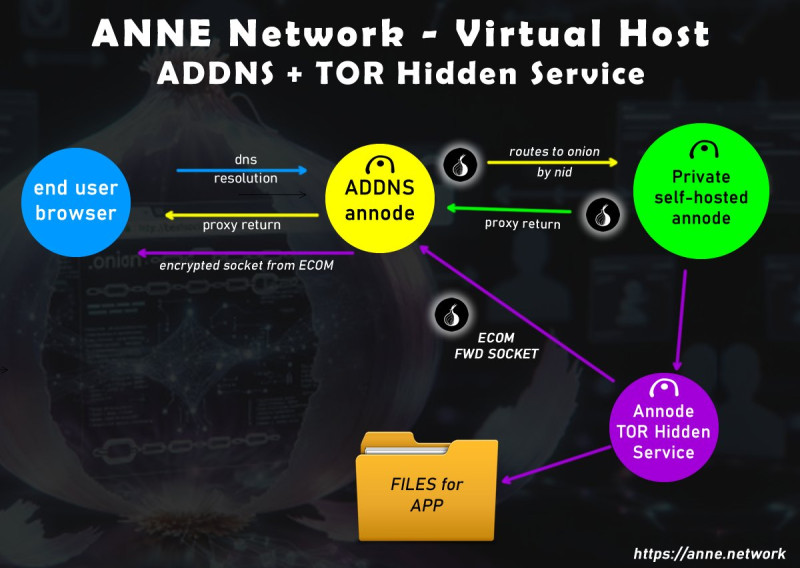
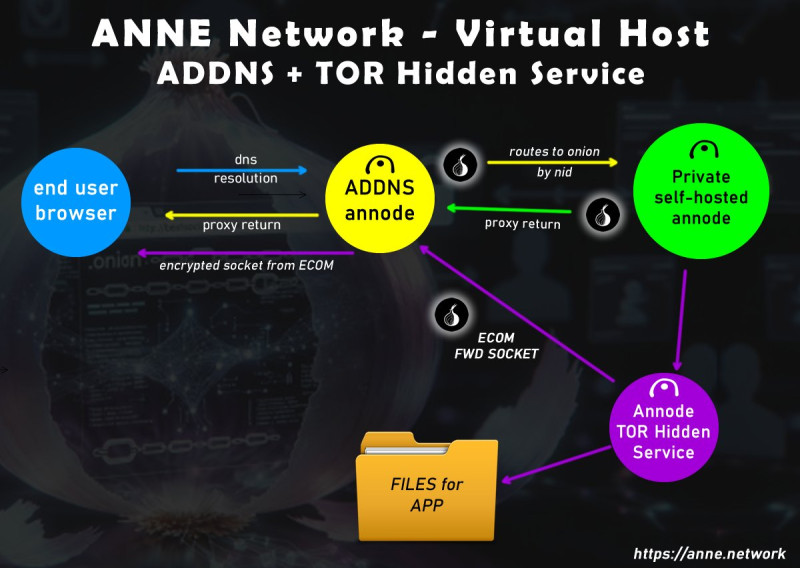
Every annode ships with an isolated Tor daemon bundled inside; just like Tor Browser. Launch the node, the daemon starts, provisions a hidden service, binds a .onion address. That onion is generated from a persistent keypair derived from the node's Neuron ID. Verifiable by every peer. NID → onion. Onion → NID.
All Ghostnet traffic flows exclusively through Tor circuits. Flood-routing logic stays identical but next-hop entries are onion addresses, not IPs. Circuit isolation per data type kills cross-app correlation.
Consensus messages, chain sync, hypergraph queries still use the fastest transport. Nodes can run in all-Tor mode or hybrid mode. The Alt Data Network becomes network-anonymous by design. Every opt-in subnetwork becomes a surveillance-proof mesh. No DNS. No certificates. No IPs.
Technical Scope : What We Build
6 months. Four modules. One bulletproof result.
Tor Daemon Integration :: Bundle Tor binary inside annode. Java lifecycle manager launches it, authenticates, provisions .onion automatically. Bridges and pluggable transports available but not required.
Onion-Address Abstraction + NID Binding – Onion keypair derived deterministically from Neuron ID. Replace all internal peer addressing with onion abstraction. Intermediate hops never see an IP.
Ghostnet Alt Data Network Adaptation: Flood-routing engine connects through Tor SOCKS proxy. Route lists, performance counters, learning caches indexed by onion address. Separate circuits per data type. VPN goes off? Local IP changes? The Annode detects this and Tor automatically reboots and finds a new set of circuits to use.
PHP-FPM Integration (unlocks everything) : Current Java servlet uses CGI. New process per request, no persistent state, no opcode caching. That means no WordPress, no Laravel, no real PHP apps. We're fixing that. Add PHP-FPM bridge. Any php app you can build can be served by your annode.
Testing, Hardening, Documentation: Multi-node test harness with adversarial relays. Clearnet leak testing. Threat-model config guides. API docs.
Release order depends on benchmarks: PHP-FPM first lets users test sites locally. Tor first delivers deterministic onion-from-NID. Both are coming.
The Cypherpunk Imperative
Governments are accelerating surveillance. Deep packet inspection. Protocol-level blocking. VPN oversight. Mandatory ID for server operators. Privacy tech is under legal siege.
This environment demands a web stack that isn't just hard to censor - but difficult by design to even map.
ANNE already replaces centralized servers with sovereign nodes. But the networking layer still leaks IPs and physicality. Onion transport kills that leak. The result: a P2P application fabric with no network-level footprints. No IP logs. No traffic analysis signals. No address that can be blocked or geolocated.
You run localhost. You are your own server. You access apps without leaving localhost. Clearnet users reach you via Tor/ADN through a normal browser.
Default must be private by design. Users can generate as many NIDs as they want. As many identities. These aren't "real world" identities. They're key pairs.
A network invisible at the routing layer is the only sustainable substrate for permissionless innovation.
Funding & Rewards : Pledge-Based Swap
You contribute Monero. You receive ANNE Coin from the Development Fund. Early support = better swap ratio than the public gets later.
Reward tiers:
Pledge — ANNE Coin Reward — Bonus
- < 0.1 XMR — 100% swap value —
- ≥ 0.1 XMR < 1.0 XMR — 100% + 20% — Early AMail access
- ≥ 1.0 XMR < 10.0 XMR — 100% + 50% — Early AMail + social mention
- ≥ 10.0 XMR — 100% + 100% — Early AMail + permanent mention on anne.network (pulled from hypergraph)
AMail early access: Encrypted, serverless email delivered via annode relays. Not replacing email - freeing annode operators from centralized email. Priority routing. E2E encrypted BASED messaging first. AMail handles secure "external" email delivery to a Neuron Identity.
The process:
Send Monero via Kuno. Save your Transaction ID + Transaction Key.
Go to https://www.anne.network:9116/aon.html → generate new ANNE account. Save your SEED, NID, PUBLIC KEY.
Comment below with your Monero TX ID + TX Key. In Private message to creator, include: NID, PUBLIC KEY, custom alias (for AMail), optional contact email.
You receive ANNE coins + rewards as they become available.
You acquire a direct economic stake in ANNE at a favorable rate. Early entry into a private communication stack built on the infrastructure you help complete.
If the network succeeds and token utility grows, your holding appreciates. If your motivation is purely ideological, your Monero goes directly into auditable code that hardens the mesh for everyone.
About ANNE
A hybrid P2P data system. Semantic transforms + cash system = queryable local-server at Layer One. No third-party data intermediaries.
1Schema: semantic triplet data model, immutable, verifiable.
Neuromorphic hypergraph: in-memory query structure for global service discovery.
Alt Data Network: request-response mesh that replaces backend servers (Tor-hardened by this campaign).
ANTOR: swarming file transfer for large files.
PoST consensus: proof-of-space-time securing the datachain.
Resources
Official: https://anne.network
Community: https://anne.media
Get your own annode running: https://anne.media/anne-wizard-anne-installation-suite
Final Word
Decentralized infrastructure without anonymous transport is an illusion. The Alt Data Network can already eat centralized backends for breakfast but only with untraceable onion addresses can it be truly unstoppable.
Truly distributed dApps. Uncensorable social networks. Unstoppable marketplaces. Pure P2P. E2EE calls, messages, encrypted email.
The Tor-hardened Alt Data Network enables Monero-native applications to run entirely on sovereign nodes backed by the same values that made Monero the standard for private transactions. This is infrastructure for every Monero developer who needs a backend that reveals nothing.
Support the Tor onion integration. Add PHP-FPM. Ship the release. Become the cloud. Become un-knockable.
Contribute Monero. Stake your claim. Help finish the mesh.
Thank you for your support.
Reach out to us on X...
...or join ANNE Forum at https://annetalk.org to discuss all things ANNE and beyond.
Campaign managed by ANNE Network and endorsed by ANNE Media
Contact: https://x.com/ANNE_p2p
Published: 2026-05-10
Supporters
Browse 1-10 of 12 kuno

Time to give back to the community
Write a comment
Support
Send any amount of Monero to:
423Phpf8XWs39zJn5M51GVRJ58i4qQ3m8a7mrwBRviukQbAKW2YJ1vG7USCD9cUvS2efAA1NEm9m4bpzXsBsUoR1DXfkQK4
Open in walletNo Monero? No problem...
✓ You donate directly to the recipient’s wallet
✓ No platform fees
✓ Donations are synced every 5 minutes
✓ You donate directly to the recipient’s wallet
✓ No platform fees
✓ Donations are synced every 5 minutes
Share
Copy the link to share this kuno with friends or social media: